Draw on a plate, add water, and watch your drawings peel away and start to float.
Area
Chemistry · Mixtures, Solubility
Physics · Fluids
Time
Short
Wow
Very surprising
Mess
A little
01
Prepare
5 materials and a question to think about first.
02
Try
5 steps on a single screen, to follow as you go.
03
Understand
What happened and why, for the child and for the adult.
You'll need
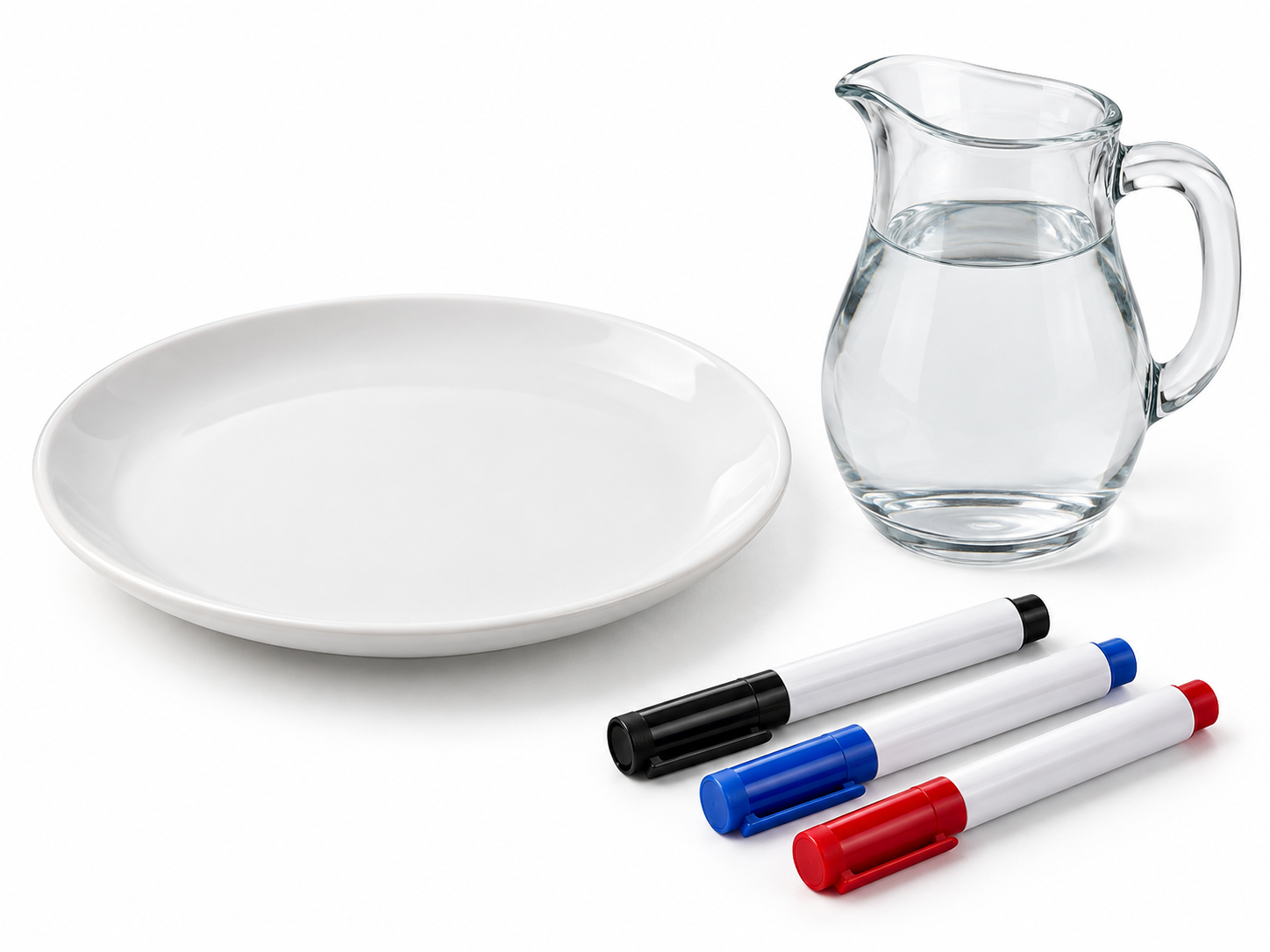
A shallow glass or ceramic plate with a smooth, glossy bottom · A dry-erase marker for a whiteboard (not a permanent marker) · Room-temperature water · A cup or small pitcher for pouring the water · Paper towels or a dish towel
Is Aporeva useful to you?
Aporeva is a free and independent project. If you want, you can help cover its basic running costs.
Use dish soap, salt, and cold alcohol to extract DNA-rich material from strawberries and examine its strands.
Time · Long
Wow · Surprising
Mess · A lot
01Prepare
What we need and what we think will happen.
Materials
Preparation
•Choose a plate with a smooth, untextured bottom and place it on a stable table.
•Wash the plate, rinse it well, and dry it completely before drawing.
•Use a dry-erase whiteboard marker. Regular, washable, or permanent markers will not give the same results.
🔮 Before you start
What do you think will happen when the water reaches your drawing?
Do you think it will float in one piece or break apart?
Ask them and listen to the answer. It doesn't matter if they guess right.
02Try
Hands on.
01
Step 1.
Draw on the plate
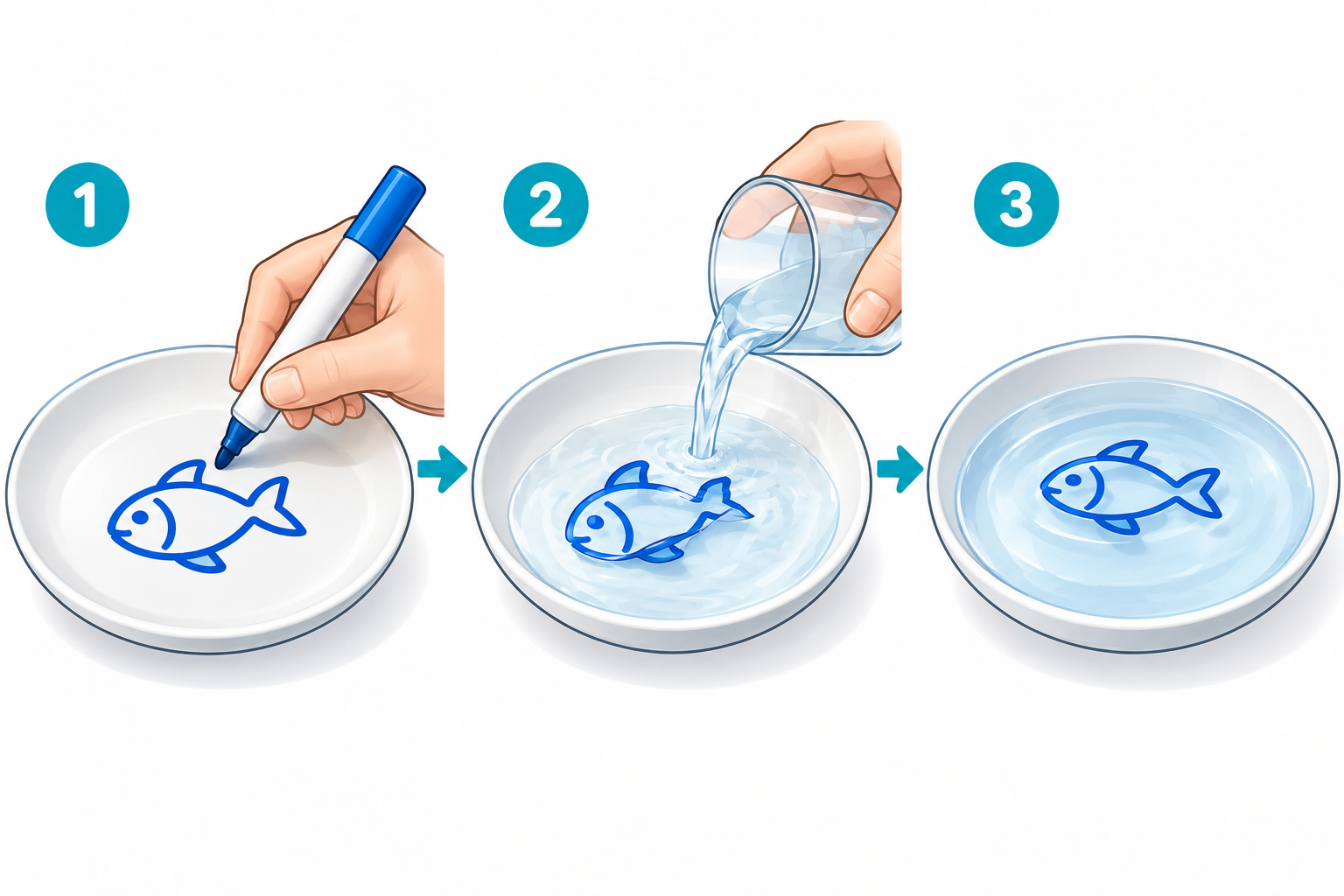
With the plate completely dry, draw a heart, a smiley face, or a fish. Make the lines fairly thick and connected to give the drawing a better chance of staying in one piece.
02
Step 2.
Let the ink dry
Wait a few seconds until the ink looks dry. Don't rub or touch the drawing.
03
Step 3.
Slowly add water
Pour water slowly down the side of the plate, not directly onto the drawing. Let it spread across the bottom until it reaches and covers the drawing.
If this step doesn't work
→If the stream of water breaks up the drawing, empty and dry the plate. Draw it again and pour even more slowly.
04
Step 4.
Watch it lift off
Wait a few seconds and see whether the ink starts to separate from the plate and rise to the surface. If nothing happens, gently move the plate to help water get underneath the ink.
05
Step 5.
Make your drawing dance
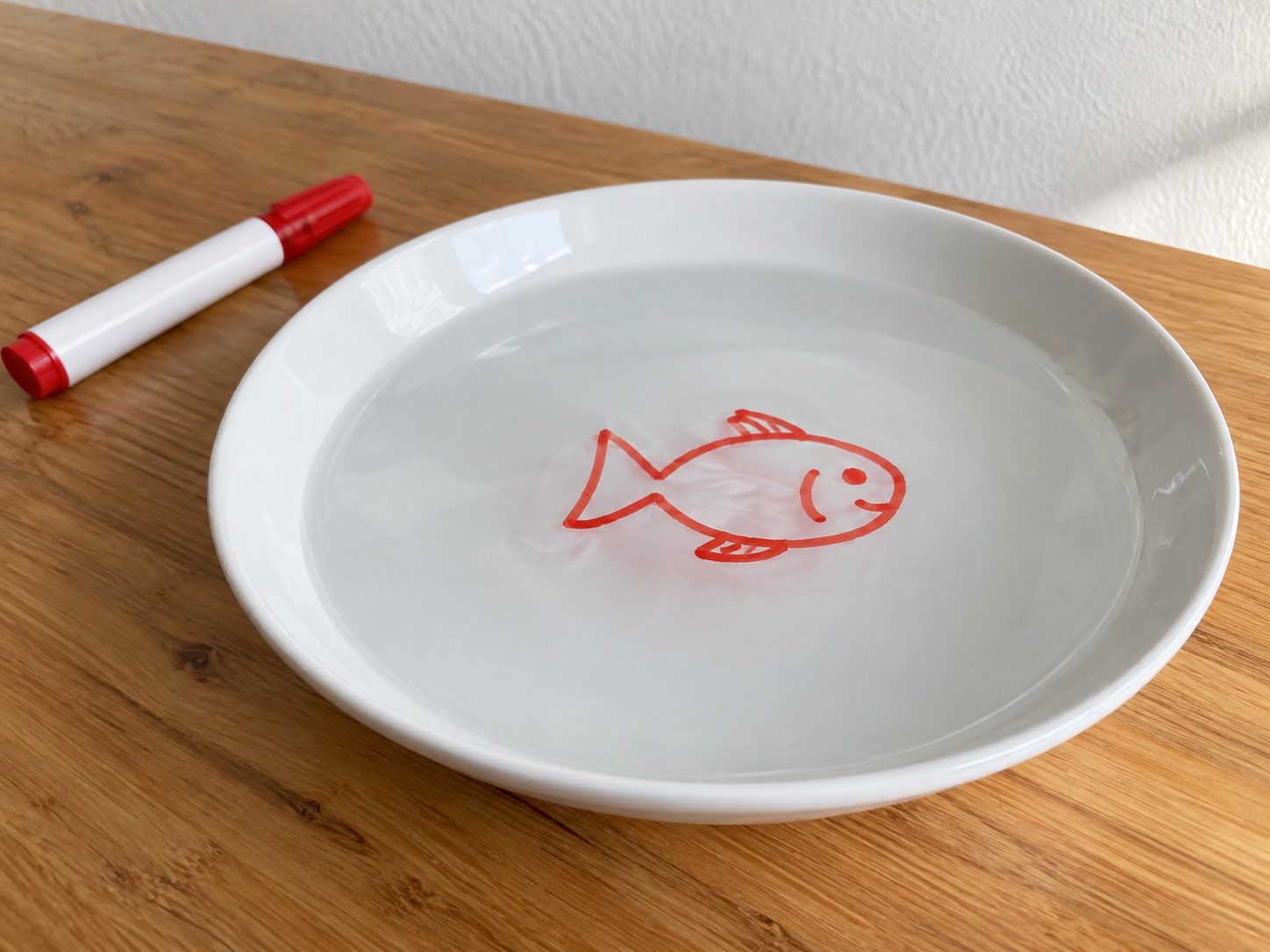
If your drawing is floating, carefully move the plate from side to side and watch it drift across the water.
Step-by-step diagram
03Understand
What happened and why.
What happened
With the right marker and surface, the drawing may peel off the plate as a very thin film and float. Some drawings hold their shape, while others break into little pieces.
👧 To explain it to a child
Dry-erase marker ink doesn't stick very strongly to a smooth plate. When water reaches the drawing, it can slip underneath and lift it up like a very thin sticker. Because this ink doesn't mix easily with water, the drawing may float.
🧑 For the adult: what's going on?
Dry-erase markers contain pigments, an evaporating solvent, and polymer components that help the ink release from smooth, nonporous surfaces. As the drawing dries, it forms a film that adheres only weakly to the plate.
What you learn
•Different inks can stick differently to the same surface.
•Not all materials mix with water.
•A thin film can peel away and float without immediately falling apart.
💭 To talk about
—Which part of the drawing lifted off first?
—Did it stay in one piece when it started floating?
—How did it move when you tilted the plate just a little?
🧪 Let's try something else
Does line thickness matter?
Using the same marker, make two drawings of the same size: one with thin lines and one with thick lines.
Thin lines · Thick lines
We change
The thickness of the lines.
We keep the same
The marker, plate, size of the drawings, and the way you add the water.
We observe
Which drawing lifts off first, and whether each one floats in one piece or breaks apart.
Variations
Easier
Keep it simple. Start with a heart made of thick, connected lines. Very fine details are more likely to break apart.
Another challenge
Try a spoon. Draw a small shape on the clean, dry back of a smooth metal spoon. Let it dry, then lower that part very slowly into a bowl of water to see if the ink peels off and floats.
More scientific
Compare colors. Try different colors of dry-erase markers. Use the same plate and make drawings of similar sizes to see whether they peel off in the same way.
Is Aporeva useful to you?
Aporeva is a free and independent project. If you want, you can help cover its basic running costs.