Physics
Extendable Cardboard Grabber
Build a long grabber from jointed cardboard strips. Move the handles to open and close the tips and pick up lightweight objects.
- 01
Prepare
6 materials and a question to think about first.
- 02
Try
8 steps on a single screen, to follow as you go.
- 03
Understand
What happened and why, for the child and for the adult.
You'll need
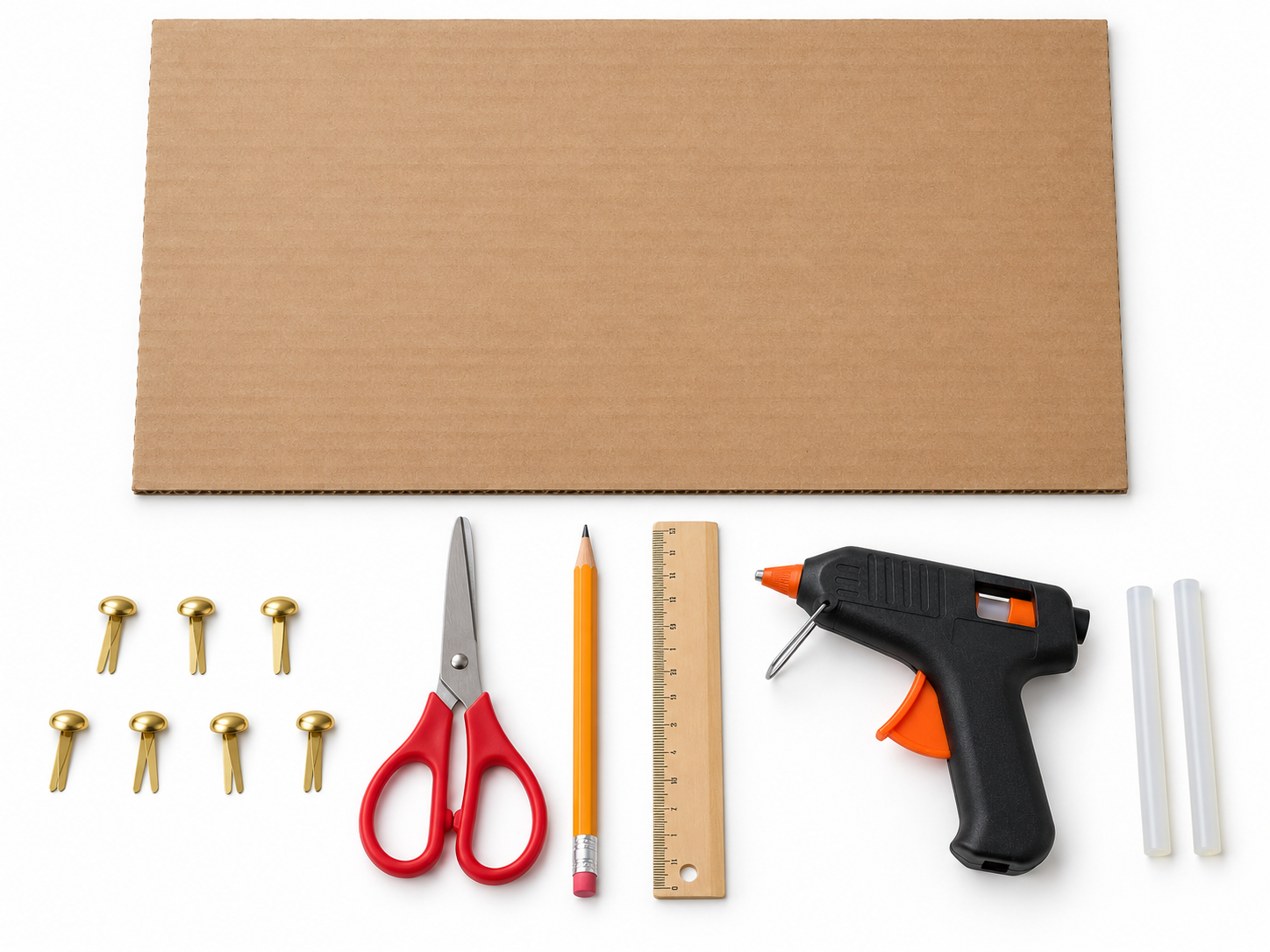
Sturdy corrugated cardboard · 7 brass paper fasteners (split pins) · Scissors · Pencil and ruler · Hot glue gun and glue sticks · A sheet of paper for the test ball
Is Aporeva useful to you?
Aporeva is a free and independent project. If you want, you can help cover its basic running costs.
Help keep Aporeva running →Aporeva started with a question
I started this project while looking for interesting things to do with my daughter and ways to nurture her curiosity about how the world works.
Discover the story behind Aporeva →If you liked this one…
Same topic · Mechanics
Rubber Band-Powered Car
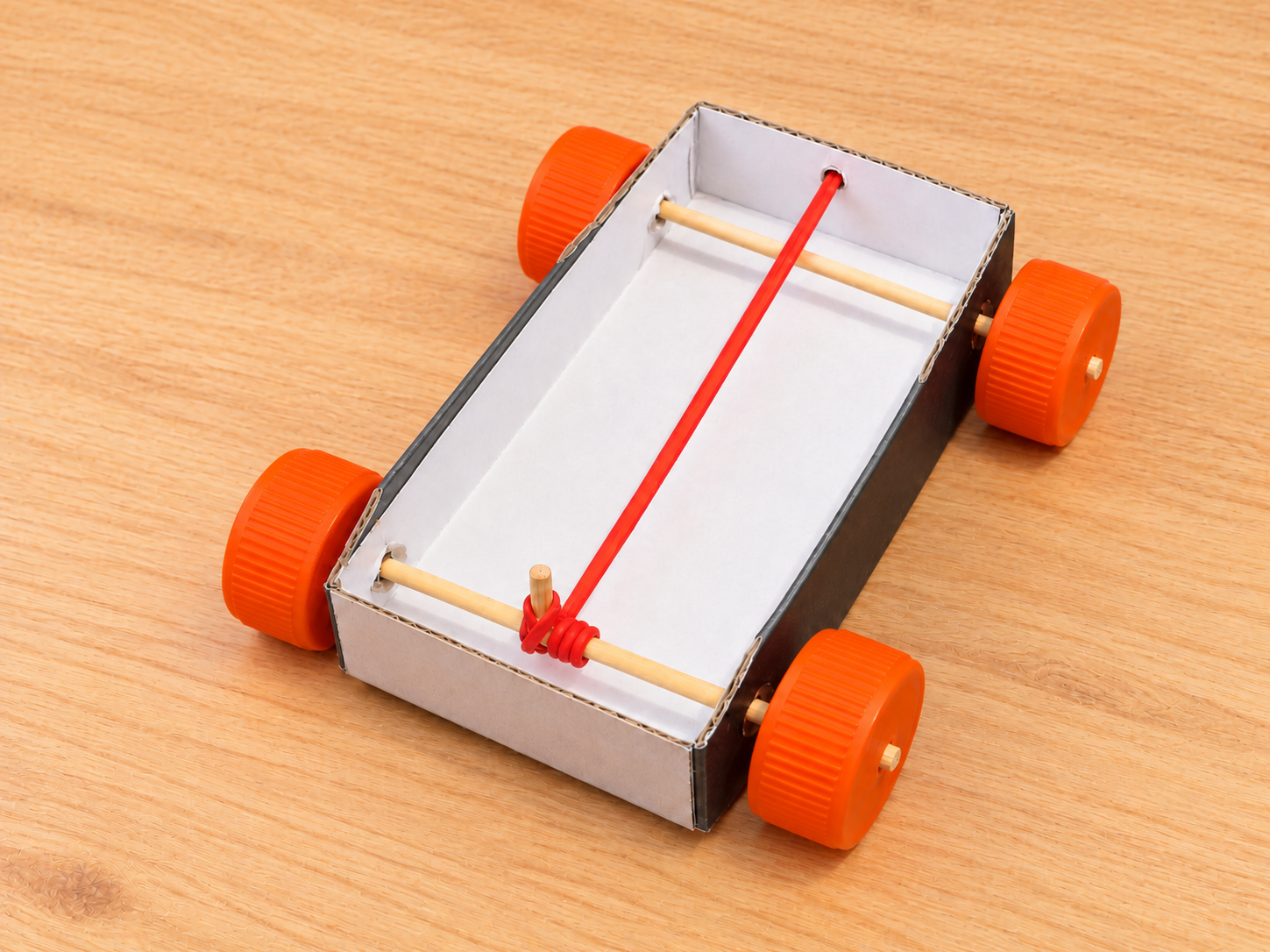
Build a rubber-band-powered car from a cardboard box and bottle caps. Wind the rear wheels and watch it move without batteries.
- Time · Long
- Wow · Very surprising
- Mess · A little
Same topic · Mechanics
Build a Hydraulic Crane
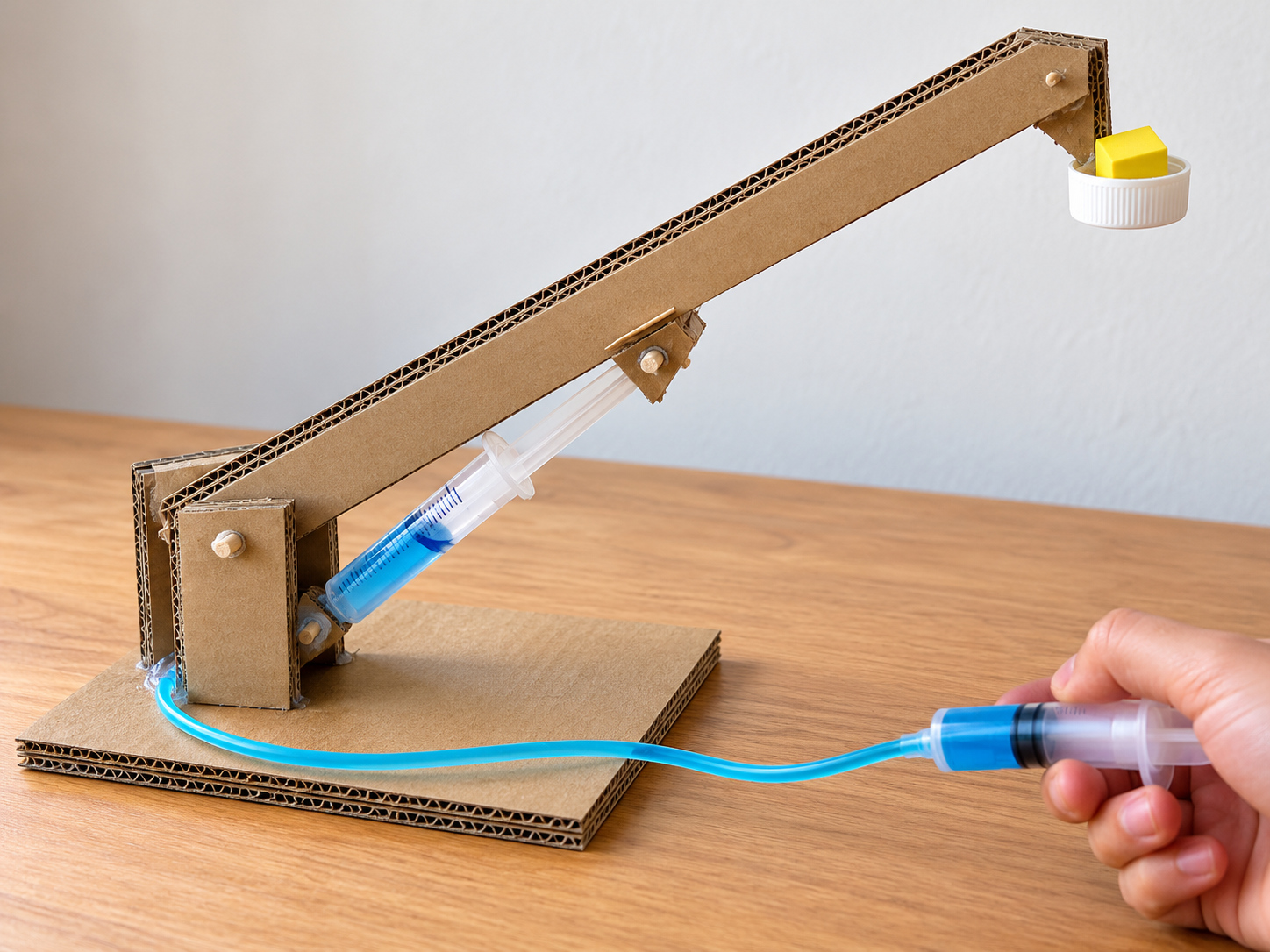
Build a small cardboard crane and move its arm up and down with two syringes connected by water. Control a machine you built yourself!
- Time · Long
- Wow · Very surprising
- Mess · A little
Same topic · Mechanics
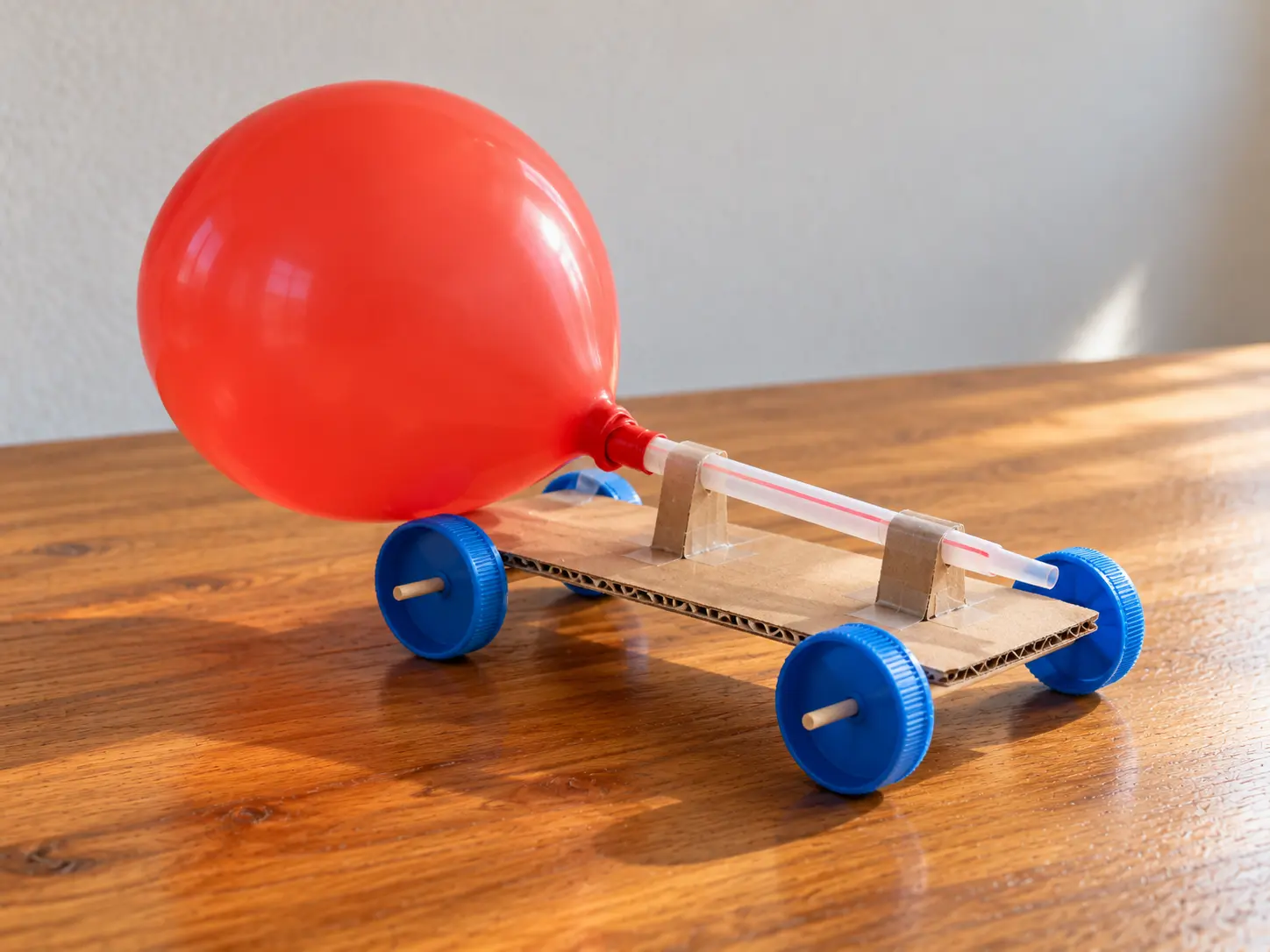
Balloon-Powered Car
Build a cardboard car with freely spinning axles and propel it using air from a balloon.
- Time · Long
- Wow · Surprising
- Mess · None

Another area · Chemistry
Liquid Density Tower
Carefully stack liquids of different densities and watch them form layers that may slowly mix over time.
- Time · Medium
- Wow · Surprising
- Mess · A little
01Prepare
What we need and what we think will happen.
Materials

🔮 Before you start
What do you think will happen to the tips when you bring the handles together?
What object do you think the grabber will be able to hold?
Ask them and listen to the answer. It doesn't matter if they guess right.
02Try
Hands on.
- 01Step 1.
Cut the pieces
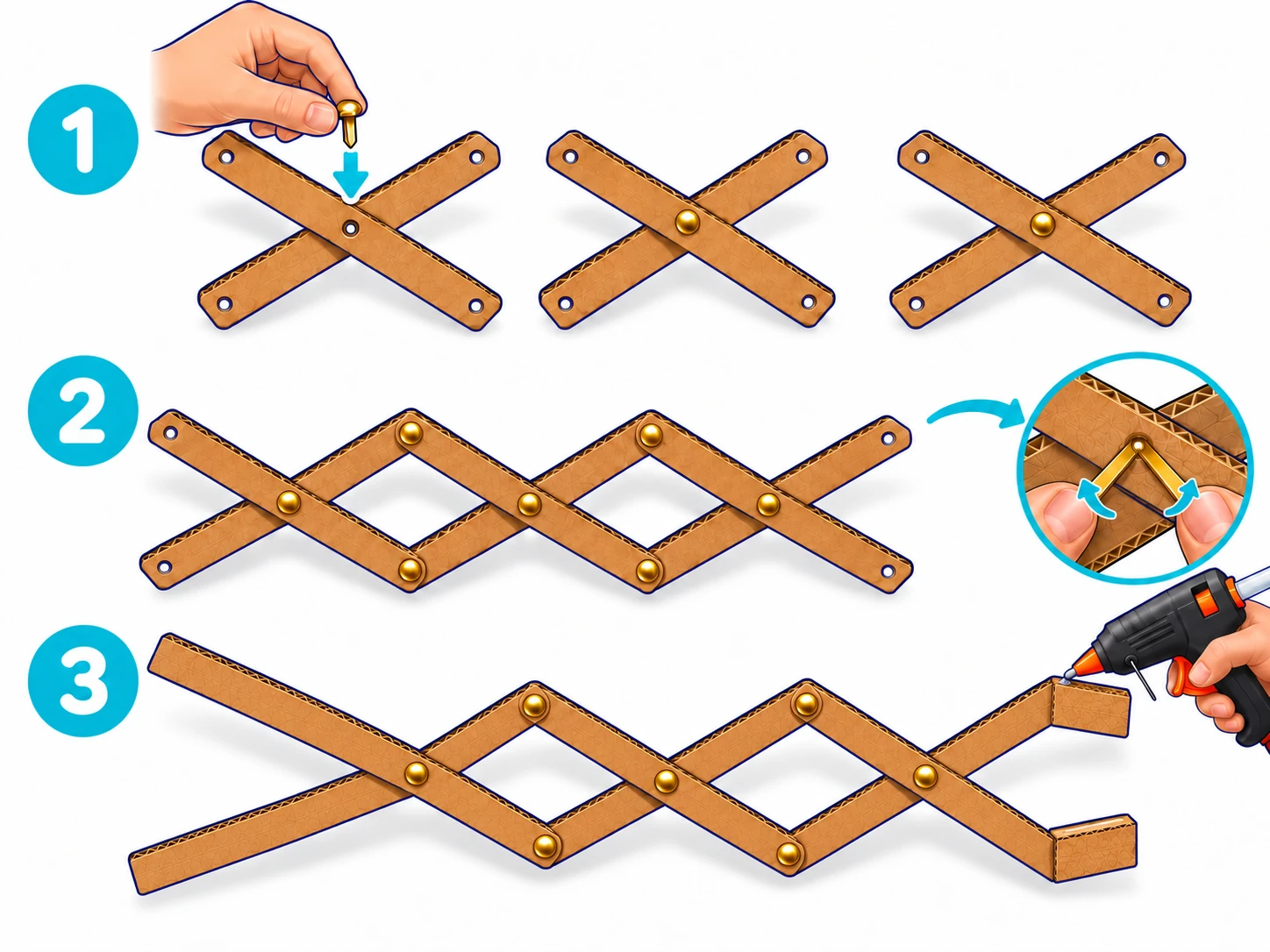
Have an adult help cut 6 identical strips of sturdy corrugated cardboard, about 24 × 3 cm (9½ × 1¼ in). Cut 2 more strips measuring 8 × 3 cm for the handles and 2 measuring 6 × 3 cm for the tips. Run the corrugation channels along the length of the strips and keep them straight.
- 02Step 2.
Mark and make the holes
On each long strip, mark the center and a point 2 cm from each end. Have an adult push a pencil tip through the marks with the cardboard resting on a surface that can be marked.
If this step doesn't work
- →Make the holes just wider than the fastener shafts so the strips can turn without wobbling.
- 03Step 3.
Make three crosses
Overlap the long strips in pairs to make 3 X shapes. Push a brass fastener through the center hole of each X and spread its legs on the back without squeezing the cardboard tightly.
- 04Step 4.
Connect the X shapes
Line up the three X shapes. Join the upper-right end of the first to the upper-left end of the second, then repeat at the bottom; connect the second and third the same way. Use four fasteners for these connections and alternate the layers of cardboard so the assembly stays flat.
If this step doesn't work
- →If the mechanism twists, check that the strips follow the same connection pattern and that each X can pivot.
- 05Step 5.
Test the movement
Before gluing on the extra pieces, hold the two free ends at one side and slowly bring them together. Watch the mechanism get longer as the ends on the opposite side move closer together. Spread the handles to reverse the movement without forcing the joints.
- 06Step 6.
Glue on the handles
Have an adult hot-glue an 8 × 3 cm strip onto each free end at one side, extending it in the same straight line with matching corrugation direction. Overlap about 3 cm of the flat faces; do not glue only the edges or let glue reach the fasteners. Allow the glue to cool.
- 07Step 7.
Glue on the tips
At the other end, position the two 6 × 3 cm strips over the free ends, angled inward to face each other. Have an adult glue about 3 cm of each strip's face onto its bar, without bending the bar or adding fasteners: these joints stay rigid. Let the glue cool before moving the grabber.
- 08Step 8.
Pick up a light object
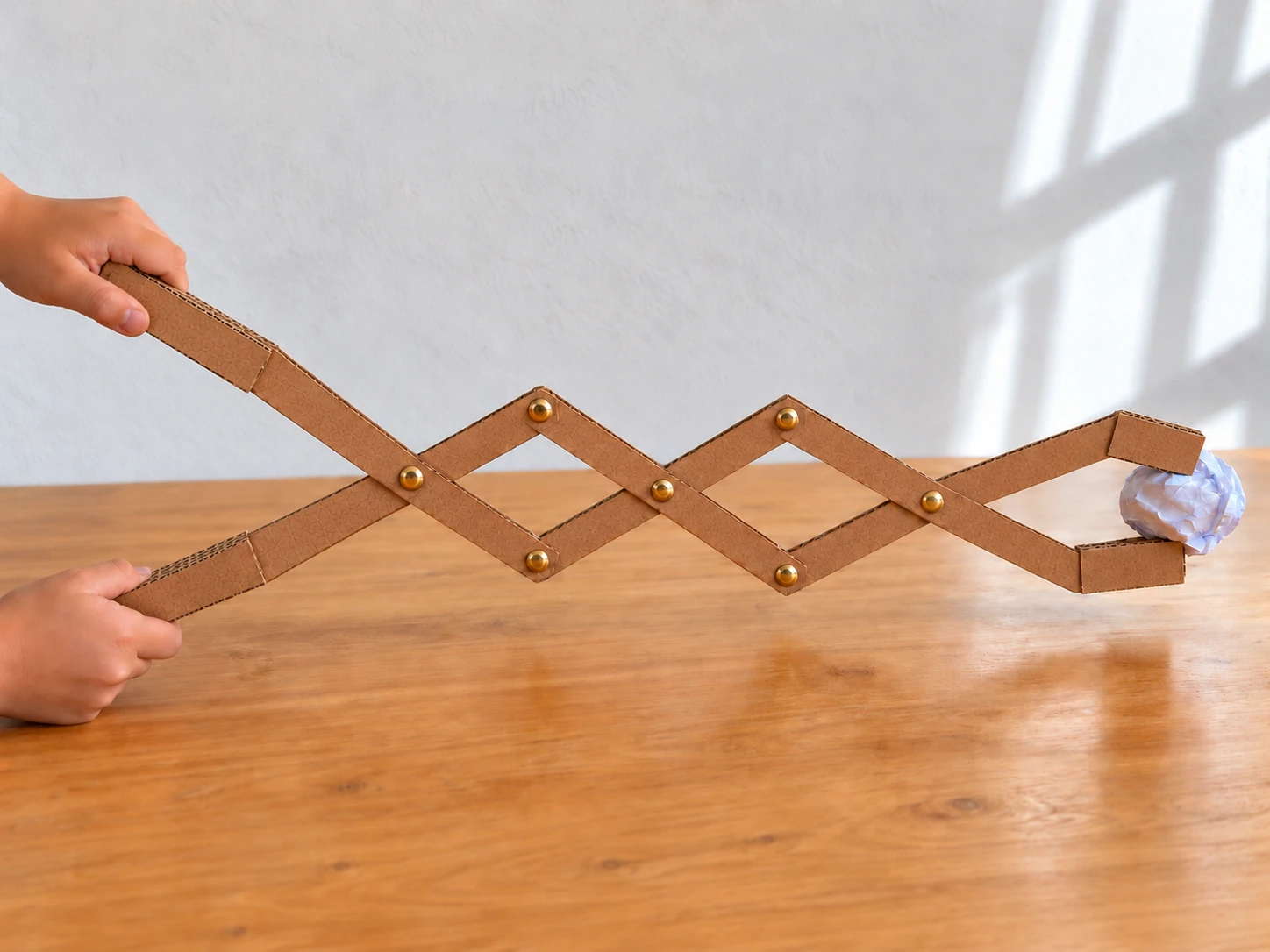
Crumple the paper into a lightweight ball and place it between the open tips. Gently bring the handles together to grip it and lift it just above the table. If it does not touch both tips, try a larger ball.
If this step doesn't work
- →If the cardboard bends, replace the strips with sturdier corrugated cardboard.

03Understand
What happened and why.
What happened
As you bring the handles together, the X shapes extend lengthwise and the tips move closer together. If the joints turn freely and the jaws face each other, the grabber can hold a lightweight paper ball.
👧 To explain it to a child
The strips cross and turn around the fasteners. When you move the handles, the connected strips carry that movement all the way to the tips.
🧑 For the adult: what's going on?
The strips and fasteners form a mechanical linkage: the fasteners let the bars rotate relative to one another. With identical strips and holes in matching positions, the connections between X shapes form parallelograms that coordinate the movement.
What you learn
- •Recognize that a pivot joint lets two pieces turn without coming apart.
- •Observe how connected bars transmit motion.
- •Relate joint placement to the movement of the tips.
💭 To talk about
- —What happens to the tips and the grabber's length when you bring the handles together?
- —What would you change to make the grabber reach farther without bending?
- —What tip shape do you think would hold a paper ball better?
Variations
Change the tips
Before gluing on the tips, an adult can prepare wider or narrower pairs and choose one to try. To compare designs, build a second identical grabber with a different pair of tips and use the same lightweight ball.
Is Aporeva useful to you?
Aporeva is a free and independent project. If you want, you can help cover its basic running costs.
Help keep Aporeva running →Aporeva started with a question
I started this project while looking for interesting things to do with my daughter and ways to nurture her curiosity about how the world works.
Discover the story behind Aporeva →If you liked this one…

Same topic · Mechanics
Rubber Band-Powered Car
Build a rubber-band-powered car from a cardboard box and bottle caps. Wind the rear wheels and watch it move without batteries.
- Time · Long
- Wow · Very surprising
- Mess · A little

Same topic · Mechanics
Build a Hydraulic Crane
Build a small cardboard crane and move its arm up and down with two syringes connected by water. Control a machine you built yourself!
- Time · Long
- Wow · Very surprising
- Mess · A little

Same topic · Mechanics
Balloon-Powered Car
Build a cardboard car with freely spinning axles and propel it using air from a balloon.
- Time · Long
- Wow · Surprising
- Mess · None

Another area · Chemistry
Liquid Density Tower
Carefully stack liquids of different densities and watch them form layers that may slowly mix over time.
- Time · Medium
- Wow · Surprising
- Mess · A little